
☎. +911234567890
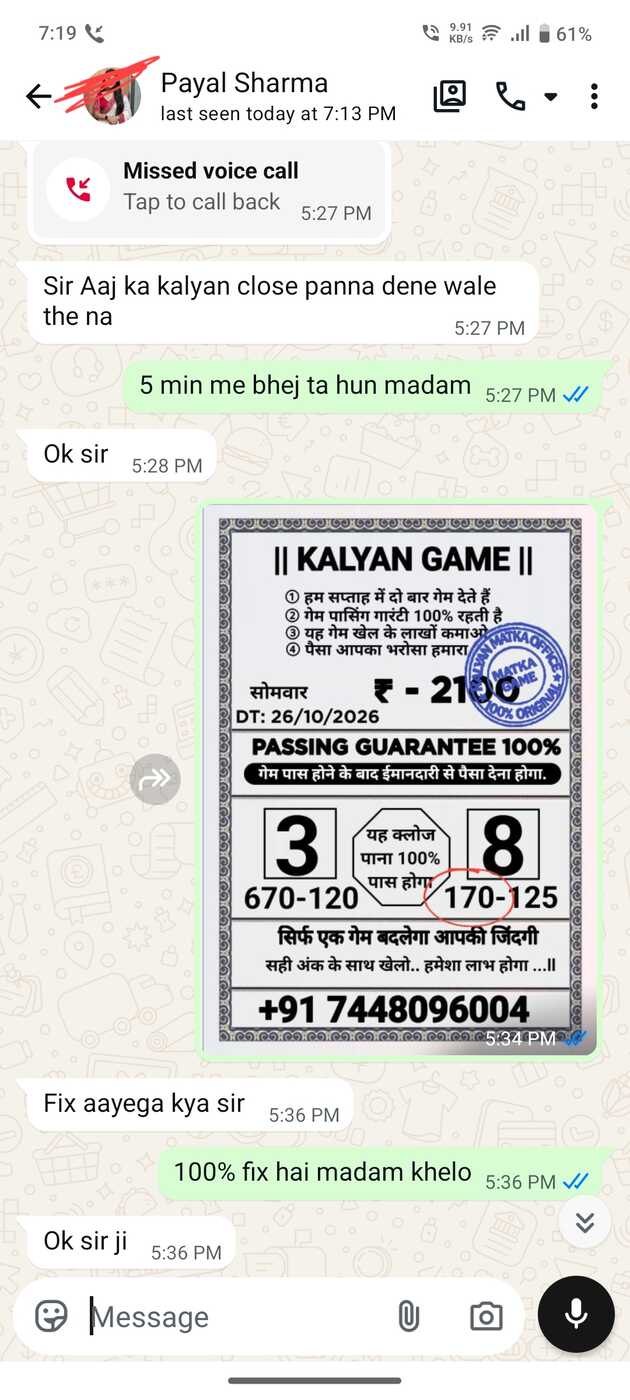
On our website you will get free weekly patti, weekly jodi and old charts of Kalyan Matka, Milan Matka, Rajdhani Matka and all markets. By looking at this you can make the game easier.
Mon. 3-8-0-5-4-9
Tue. 1-6-2-7-4-9
Wed. 1-6-3-8-2-7
Thu. 2-7-3-8-0-5
Fri. 2-7-0-5-3-8
Sat. 1-6-3-8-4-9
1 = 19 10 13 12 15
2 = 21 25 28 23 26
3 = 35 38 36 39 34
4 = 47 43 42 45 48
5 = 59 54 57 58 52
6 = 65 69 68 64 63
7 = 71 70 72 74 75
8 = 87 82 84 89 85
9 = 90 95 94 91 96
0 = 02 07 04 09 08
1 = 560 146 290 470 380
2 = 390 570 138 480 679
3 = 490 139 120 580 670
4 = 590 239 149 789 130
5 = 230 780 258 140 690
6 = 457 240 150 790 178
7 = 250 890 160 278 340
8 = 134 260 189 170 567
9 = 135 450 270 180 360
0 = 190 235 280 460 370
 ❋ ❋ CHARTS ZONE ❋ ❋
PENAL CHART
❋ ❋ CHARTS ZONE ❋ ❋
PENAL CHART Final Ank is an important term commonly used in Satta Matka result discussions. It refers to the last digit of a declared number and is often reviewed alongside previous results, Jodi records, and other Matka charts. Understanding Final Ank can make it easier to read and interpret published Matka results, whether you are researching Kalyan, Milan, Rajdhani, or other markets.
Final Ank simply means the final digit of a Matka result. For example, if a declared number is 378, the Final Ank is 8. Similarly, if the result is 452, the Final Ank would be 2.
Because it represents only the final digit, Final Ank is one of the simplest parts of a Matka result to identify. Many result charts display this information alongside the complete result so users can quickly review historical records and compare previous outcomes.
Final Ank is frequently included in Matka charts because it provides a simple way to organize and compare previous results. Users reviewing historical information may look at Final Ank records for several reasons:
Historical patterns can be interesting to study, but previous results do not guarantee or determine future outcomes. Matka results are uncertain, and no Final Ank can be considered a guaranteed prediction.
Finding the Final Ank does not require a complicated calculation. Simply look at the published result and identify its final digit.
When checking online result charts, the Final Ank may be displayed separately or can be identified directly from the published number.
Matka charts organize previous results in a structured format, making historical information easier to review. Final Ank records can be particularly useful when comparing results over different dates or markets.
Charts may include information such as previous opening results, closing results, Jodi numbers, Panel or Patti combinations, and their corresponding Final Ank values. Reviewing these records can help users understand how historical results are presented without treating past patterns as certain predictions.
Reading a Final Ank chart is generally straightforward. Start with the date and market name, locate the published result, and identify the last digit. Keeping the information arranged by date makes it easier to compare records from different sessions.
The meaning of Final Ank remains the same across different Matka markets: it is the final digit of the applicable declared number. What changes is the actual result and therefore the Final Ank associated with each market and session.
For example, a Kalyan result may have a different Final Ank from a Milan or Rajdhani result on the same date. This is why records should always be checked against the correct market, date, and session.
Some Matka participants study previous Final Ank records and charts in an attempt to identify recurring patterns. However, historical results cannot guarantee the next Final Ank. A frequently occurring digit in previous records does not mean that the same digit must appear again.
For this reason, Final Ank should be viewed primarily as a result-analysis and record-keeping element rather than a guaranteed prediction method.
Satta Matka involves financial risk, and outcomes are uncertain. Anyone researching Matka results should understand the applicable laws in their location and avoid treating predictions, charts, or historical patterns as guaranteed ways to make money.
Never risk money that you cannot afford to lose, and avoid increasing stakes to recover previous losses. If gambling stops being enjoyable or begins affecting finances or daily life, taking a break is an important step.
Here are answers to some common questions about Final Ank and its role in Matka result charts.
Final Ank refers to the last digit of a declared Matka result. For example, the Final Ank of 456 is 6.
There is no complicated calculation. Simply identify the last digit of the published result.
Previous results can be reviewed for historical patterns, but they cannot guarantee or accurately determine a future result.
Final Ank information is commonly available within published Matka result pages and historical charts. Always verify the market, date, and session before relying on a result.
The concept is the same, but the actual Final Ank depends on the declared result of each individual market and session.
It becomes available once the relevant result has been officially declared and published. Update timing depends on the particular market and result source.
No. Final Ank is simply part of a published result. It does not guarantee a future outcome or a financial return.
Yes. Historical Final Ank records can make it easier to organize and compare previously published results across dates and markets.
Final Ank refers to a single last digit of a result, while Jodi generally refers to a two-digit combination. They are separate elements commonly shown in Matka result charts.
Accuracy depends on the source publishing the result. Users should cross-check important information and rely on clearly identified, consistently updated result records.
Final Ank is one of the easiest Matka result elements to understand because it represents the final digit of a declared number. It is commonly used in historical charts and result records for markets such as Kalyan, Milan, Rajdhani, and others.
Understanding how Final Ank works can make Matka charts easier to read and compare. At the same time, historical data and number patterns should never be treated as guarantees of future outcomes. Keep the focus on accurate information, responsible decision-making, and awareness of the legal and financial risks associated with gambling.
 ALL MATKA 220
PATTI
ALL MATKA 220
PATTI

